
How Car Lease Payments Work in Hazelwood, MO (2026)
Break down how a Hazelwood car lease payment is built — cap cost, residual, money factor and taxes — so you can spot a strong deal before you sign.
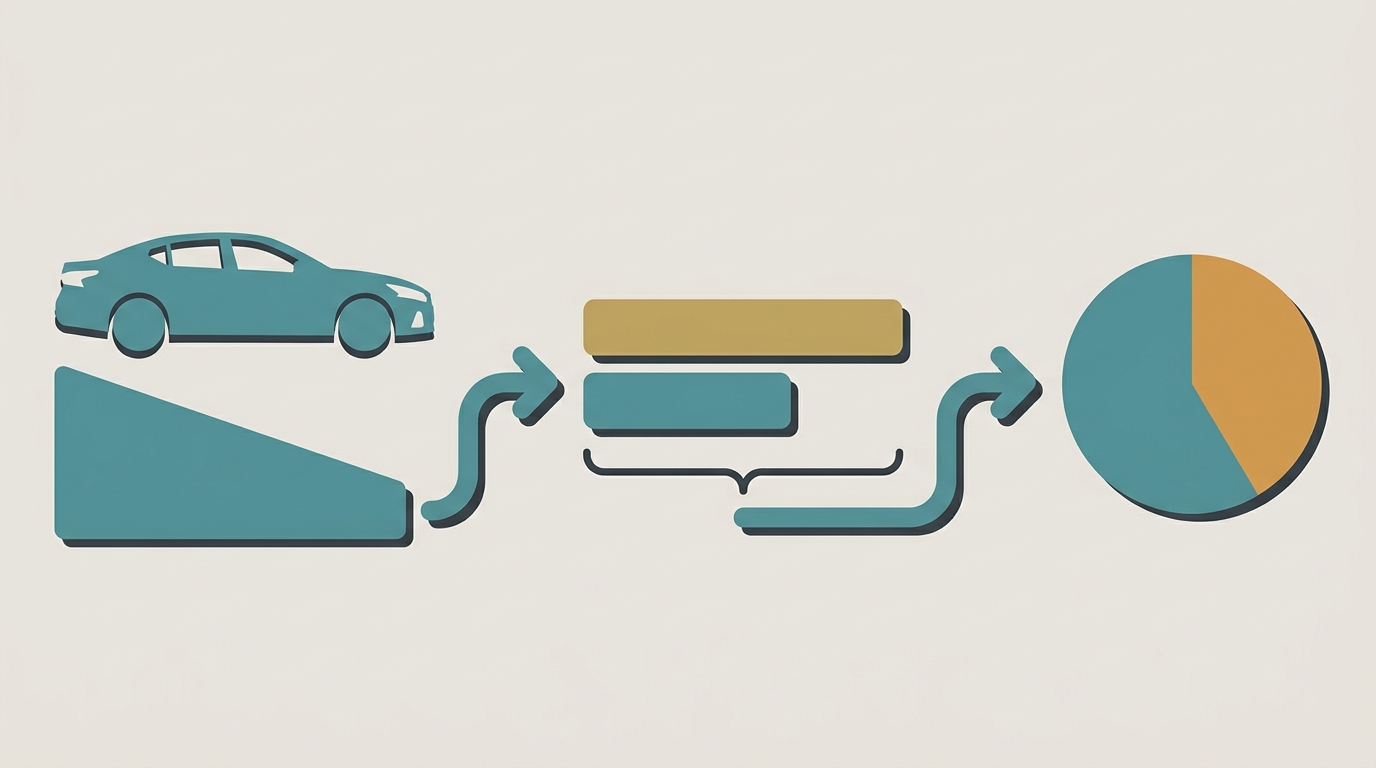
A monthly car lease payment in Hazelwood is built from three parts: a depreciation charge (how much value the vehicle loses during your term), a rent charge (the financing cost, calculated from the money factor), and applicable Missouri taxes. Understand those three levers and you can read any lease worksheet a Hazelwood dealership hands you — and recognize where the real negotiating room sits.
What exactly makes up a monthly lease payment?
A lease payment equals monthly depreciation plus a monthly rent (finance) charge plus tax. Depreciation is the adjusted capitalized cost minus the residual value, divided by the lease term in months. The rent charge is the adjusted cap cost plus the residual value, multiplied by the money factor. Together they explain every dollar on the worksheet.
Put plainly, car lease payments include taxes, the depreciation of the car, and interest. You are not paying for the whole vehicle — you are paying for the slice of value it loses while you drive it, plus a financing fee for the lender's capital.
How is the capitalized cost set — and what can you negotiate?
The capitalized cost is the lease version of the purchase price. It starts with the agreed vehicle price plus any eligible rolled-in costs such as acquisition fees or optional products, and it becomes the adjusted capitalized cost once any cap cost reduction — a down payment, trade-in equity, or rebate — is subtracted. A lower adjusted cap cost pulls both the depreciation charge and the rent charge down.
According to Kelley Blue Book, the capitalized cost is the lease version of the purchase price and can be negotiated. That is the single most important sentence on this page: the sticker is a starting point, not a given. Shoppers at Bommarito Nissan Hazelwood should treat the selling price of a 2026 Rogue or Altima the same way they would if they were buying it outright — because the number that lands in the cap cost is the number that drives every month's payment.
Where the destination fee lands
Manufacturer destination charges are set by Nissan and typically roll into the capitalized cost. For reference, the 2026 Nissan Rogue, starting at $29,690 (as of October 2026) carries a destination fee of $1,575, the 2026 Nissan Altima, starting at $27,580 (as of October 2026) carries a destination fee of $1,275, and the Destination fee — 2026 Nissan Frontier, $2,245 (as of October 2026) carries a destination fee of $2,245. These are not negotiable line items — but knowing they are already baked in helps you read a worksheet accurately.
How does the money factor work, and how do you convert it to an APR?
The money factor is the financing cost of a monthly lease payment, expressed as a small decimal rather than a percentage. That one multiplication tells you whether the financing rate you are being offered is competitive.
That is why pre-qualifying matters before you sit down to negotiate.
Why does residual value swing the payment so much?
Residual value is the lender's estimate of what the vehicle will be worth at lease-end, and it sets the floor on how much depreciation you are charged for. A higher residual value generally means less depreciation is charged during the lease, resulting in a lower monthly payment. Two identical Nissans with different residuals will quote at very different payments — even with the same selling price and money factor.
Residuals are set by the lender, not the dealer, which is why the same vehicle leases better in some months than others. You cannot negotiate the residual, but you can shop lease terms: car leasing terms are usually 24 to 36 months, and residuals shift with the term.
How do the pieces fit together in a worked example?
Walk through the math on a hypothetical 36-month lease. Suppose the adjusted capitalized cost after your cap cost reduction is $30,000, the residual value is $18,000, and the money factor is 0.0023. Monthly depreciation is ($30,000 − $18,000) ÷ 36 = $333.33. Monthly rent charge is ($30,000 + $18,000) × 0.0023 = $110.40. Pre-tax payment: about $443.73.
Now change one variable. Push the adjusted cap cost down to $28,500 and the depreciation falls to $291.67 and the rent charge to $107.
This example is illustrative only; actual residual values, money factors, and Missouri tax treatment vary by vehicle, lender, and the lessee's address, and should be confirmed on the lease contract's disclosures.
What local factors shape a Hazelwood lease?
Hazelwood sits in north St. Louis County along the I-270 corridor, and most lease shoppers here are commuting into downtown St. Louis, St. Charles, or the airport area — meaning annual mileage matters. Lease mileage caps vary by contract, and excess mileage penalties can add up quickly at lease-end.
Pick the mileage tier that matches your real driving. A St. Louis County commuter who racks up 14,000 miles a year on a 12,000-mile lease will owe hundreds at turn-in — money that would have cost far less if bought upfront in the contract.
Missouri sales tax treatment on leases depends on the lessee's address and lease structure, not solely the dealership's location, so confirm the applicable rate with the Missouri Department of Revenue or the tax disclosure printed on your lease contract.
A note on the Hazelwood finance desk
Bommarito Nissan Hazelwood's finance department works with over 30 banks and credit unions to provide financing options, and offers pre-qualification through Capital One — useful if you want a credit-driven money factor estimate before you walk the lot. For buyers with challenging credit histories, Bommarito Nissan Hazelwood also offers a Second Chance Finance program, including guaranteed credit approvals.
"Shout out to OZ and the finance staff for such a pleasant car buying experience! Very professional, informative and personable! Our family highly recommends their team for anyone in the market." — 5★ · Christina, Sep 2026
How does a lease payment compare to financing the same car?
Leasing often results in lower monthly payments compared to financing the same vehicle, because a lease charges you only for depreciation during the term rather than the full purchase price. The tradeoff: at the end of financing you own the car; at the end of a lease you return it or buy it out at the residual price.
| Factor | Lease | Finance |
|---|---|---|
| What you pay for | Depreciation + rent charge | Full purchase price + interest |
| Typical term | 24–36 months | 60–84 months |
| Mileage limits | 10,000–15,000/year | None |
| End of term | Return, buy, or re-lease | You own the vehicle |
| Monthly payment | Generally lower | Generally higher |
Lease contracts set the mileage limit, monthly payment, term, and purchase option upfront — so you know your exit options the day you sign. Most leases also cover the duration of the manufacturer's warranty, according to Bommarito Nissan Hazelwood, which can minimize maintenance costs during the term.
Frequently asked questions
What is the money factor on a car lease?
The money factor is the financing cost built into a monthly lease payment — essentially the lease version of an interest rate, expressed as a small decimal like 0.0023. Multiply it by 2,400 to get the APR equivalent, so 0.0023 equals roughly 5.5% APR. Your credit score directly affects the money factor the lender quotes you.
How is the depreciation portion of a lease payment calculated?
Monthly depreciation equals the adjusted capitalized cost minus the residual value, divided by the lease term in months. If a vehicle has an adjusted cap cost of $30,000, a residual of $18,000, and a 36-month term, the depreciation charge is $333.33 per month. A higher residual or a lower cap cost both reduce this number.
Can you negotiate a lease payment at a Hazelwood dealership?
Yes. The capitalized cost — the lease version of the selling price — is negotiable, and so is the money factor in some cases, particularly if your credit supports a lower rate. Residual value is set by the lender and is not negotiable. Focus negotiating energy on the selling price and any add-ons rolled into cap cost.
What happens at the end of a car lease?
At the end of a lease term, the lessee typically has the option to purchase the vehicle at the residual price, return it, or lease a new model. Lease contracts typically spell out the purchase option upfront, so you know your options before turn-in.
How many miles per year should you choose on a Hazelwood lease?
Pick the tier that matches your actual driving — typically 10,000, 12,000, or 15,000 miles per year. Hazelwood commuters driving into downtown St. Louis or St. Charles often need the higher tier. Excess mileage penalties can add meaningful cost at lease-end, so choosing the right mileage tier from the start is important.
Does Missouri sales tax apply to lease payments?
Missouri sales tax treatment on leases depends on the lessee's address and the lease structure, not just the dealership's location. The applicable rate and whether tax is collected monthly or upfront will be disclosed on the lease contract. Confirm specifics with the Missouri Department of Revenue or review the tax disclosure on the lease worksheet before you sign.
The bottom line for Hazelwood lease shoppers
Three numbers decide your monthly lease payment: the adjusted capitalized cost, the residual value, and the money factor. Negotiate the first, verify the second, and qualify for the best version of the third. If you want a lease worksheet walked through line by line on a specific Nissan — Rogue, Altima, Sentra, Pathfinder, LEAF or otherwise — Bommarito Nissan Hazelwood at 661 Dunn Rd in Hazelwood can run the numbers with you. Call (314) 731-2228 or visit https://www.bommaritonissanhazelwood.com/ to get started.